Tsp Tac Ar-15 Ar15 M4 M16 Charging Handie Review
| ArmaLite AR-15 | |
|---|---|
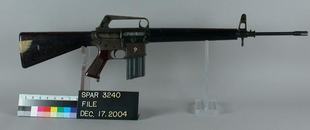 ArmaLite AR-15 with 25-round magazine | |
| Type | Attack burglarize[note one] [1] [2] [3] |
| Place of origin | Us |
| Service history | |
| In service | 1962–1963 |
| Wars | Vietnam War |
| Product history | |
| Designer | Eugene Stoner (AR-10) Jim Sullivan Bob Fremont[4] |
| Designed | 1956[5] |
| Manufacturer |
|
| Produced | 1959–1964[five] |
| Specifications | |
| Mass | 6.55 lb (2.97 kg) with 20-circular magazine[half dozen] |
| Length | 39 in (991 mm)[six] |
| Barrel length | twenty in (508 mm) |
| | |
| Cartridge | .223 Remington[half-dozen] |
| Activity | Gas-operated, rotating commodities (Direct expansion of gas on surfaces of Commodities Carrier) |
| Muzzle velocity | 3,300 ft/s (1,006 k/s)[vi] |
| Constructive firing range | 500 yd (457 one thousand) |
| Sights | Atomic number 26 sights |
The ArmaLite AR-15 [annotation two] is a select-burn down,[note 1] gas-operated, air-cooled, magazine-fed rifle manufactured in the United States between 1959 and 1964.[9] Designed past American gun manufacturer ArmaLite in 1956, it was based on its AR-10 rifle. The ArmaLite AR-fifteen was designed to exist a lightweight rifle and to fire a new high-velocity, lightweight, small-caliber cartridge to allow infantrymen to carry more than ammunition.
In 1959, ArmaLite sold its rights to the AR-15 to Colt due to financial difficulties and limitations in terms of manpower and production chapters.[1] Subsequently modifications (almost notably, the charging handle was re-located from under the conveying handle like AR-10 to the rear of the receiver),[3] Colt rebranded it the Colt 601, all the same it even so carried the Armalite markings due to contractual obligations to Armalite/Fairchild Aircraft Co.. Filly marketed the redesigned burglarize to various armed services services around the world and was eventually adopted by the U.S. military in January 1962 and subsequently designated every bit M16 rifle in Dec 1963, which went into production and service in 1964.[ix] [ page needed ] [10] [ page needed ]
Colt continued to utilise the AR-xv trademark for its line of semi-automatic-only rifles marketed to civilian and law-enforcement customers, known as Colt AR-15. The Armalite AR-15 is the parent of a multifariousness of Colt AR-15 and M16 rifle variants.
History
Afterwards World War Ii, the United States military started looking for a single automatic rifle to supervene upon the M1 Garand, M1/M2 Carbines, M1918 Browning Automatic Burglarize, M3 "Grease Gun" and Thompson submachine gun.[11] [12] However, early on experiments with select-fire versions of the M1 Garand proved disappointing.[13] During the Korean War, the select-fire M2 Carbine largely replaced the submachine gun in US service[14] and became the well-nigh widely used Carbine variant.[xv] Still, combat experience suggested that the .30 Carbine round was nether-powered.[sixteen] American weapons designers concluded that an intermediate circular was necessary, and recommended a small-caliber, high-velocity cartridge.[17]
However, senior American commanders having faced fanatical enemies and experienced major logistical problems during WWII and the Korean State of war,[18] [19] [20] [21] [22] insisted that a single powerful .30 caliber cartridge exist developed, that could non only be used by the new automatic rifle, but by the new general-purpose machine gun (GPMG) in concurrent development.[23] [24] This culminated in the development of the seven.62×51mm NATO cartridge.[23]
The United States Army then began testing several rifles to replace the obsolete M1 Garand. Springfield Arsenal's T44E4 and heavier T44E5 were essentially updated versions of the Garand chambered for the new seven.62 mm round, while Fabrique Nationale submitted their FN FAL as the T48. ArmaLite entered the contest late, hurriedly submitting several AR-10 prototype rifles in the fall of 1956 to the U.s.a. Ground forces'due south Springfield Armory for testing.[25]

ArmaLite AR-10 made by Artillerie Inrichtingen (A.I.)
The ArmaLite AR-x featured an innovative straight-line barrel/stock design, forged aluminum alloy receivers and with phenolic blended stocks.[26] It had rugged elevated sights, an oversized aluminum[27] flash suppressor and recoil compensator, and an adjustable gas organisation.[28] The final prototype, featured an upper and lower receiver with the now-familiar hinge and takedown pins, and the charging handle was on top of the receiver placed within of the carry handle.[25] For a 7.62 mm NATO rifle, the AR-10 was incredibly lightweight at but vi.85 pounds (3.11 kilograms) empty.[25] Initial comments by Springfield Arsenal exam staff were favorable, and some testers commented that the AR-10 was the best lightweight automated burglarize always tested by the Arsenal.[29] [thirty]
In the cease the United States Army chose the T44, which entered service as the M14 rifle,[23] which was an improved M1 Garand with a 20-circular magazine and automated fire capability.[31] [32] [33] The U.S. also adopted the M60 general purpose machine gun (GPMG).[23] Its NATO partners adopted the FN FAL and HK G3 rifles[notation three], and the FN Magazine and Rheinmetall MG3 GPMGs.
The first confrontations between the AK-47 and the M14 came in the early role of the Vietnam War. Battlefield reports indicated that the M14 was uncontrollable in full-machine and that soldiers could not carry plenty ammo to maintain fire superiority over the AK-47.[31] [34] While the M2 Carbine offered a high rate of fire, it was under-powered and ultimately outclassed by the AK-47.[35] A replacement was needed: a medium between the traditional preference for high-powered rifles, such as the M14, and the lightweight firepower of the M2 Carbine.
Scaling downward the ArmaLite AR-10
Every bit a result, the Army was forced to reconsider a 1957 request by Full general Willard Chiliad. Wyman, commander of the U.S. Continental Army Command (CONARC), to develop a .223 quotient (v.56 mm) select-fire rifle weighing 6 lb (ii.7 kg) when loaded with a xx-round magazine.[11] The 5.56mm round had to penetrate a standard U.S. M1 helmet at 500 yards (460 meters) and retain a velocity in excess of the speed of sound, while matching or exceeding the wounding power of the .30 Carbine cartridge.[36] This asking ultimately resulted in the development of a scaled-downward version of the ArmaLite AR-10, chosen the ArmaLite AR-15 burglarize.[9] [3] [37]
In 1958, ArmaLite submitted 10 AR-15s and one hundred 25-circular magazines for CONARC testing.[3] The tests found that a five to seven man team armed with AR-15s had the aforementioned firepower as an 11 man team armed with M14s[38] and soldiers armed with AR-15s could also carry three times more ammunition than those armed with M14s (649 rounds vs. 220 rounds).[39] The AR-fifteen was found to be 3 times more reliable than the M14 rifle.[iii] Still, General Maxwell Taylor, then Regular army Primary of Staff, "vetoed" the AR-15 in favor of the M14.[3] In 1959, ArmaLite—at present frustrated with the lack of results and suffering ongoing financial difficulties—sold its rights to the AR-ten and AR-xv to Colt.[1]
-

Early ArmaLite AR-15 without flash hider or magazine
-
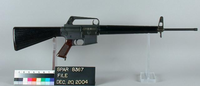
Early ArmaLite AR-15 without magazine or flash hider
-

ArmaLite AR-15 with 25-round magazine and wink hider
Filly era
Subsequently acquiring the AR-xv, Colt promptly redesigned the rifle to facilitate mass production. Based on the last ArmaLite pattern, virtually notably, the charging handle was re-located from under the carrying handle, similar the earlier AR-10 to the rear of the receiver, like the later on M16 rifle.[three] Filly and so renamed and rebranded the rifle "Filly ArmaLite AR-15 Model 01". Later on a Far Eastward tour, Filly made its outset sale of Filly ArmaLite AR-fifteen rifles to Malaya on September xxx, 1959. Colt manufactured their start batch of 300 Colt ArmaLite AR-15 rifles in December 1959.[40] Filly would go on to market place the Filly ArmaLite AR-xv burglarize to military services around the world.
In July 1960, General Curtis LeMay, and so Vice Primary of Staff of the Us Air Force, was impressed by a sit-in of the AR-15 and ordered 8500 rifles.[41] In the meantime, the Army would continue testing the AR-xv, finding that the intermediate cartridge .223 (5.56 mm) burglarize is much easier to shoot than the standard 7.62×51mm NATO M14 rifle.[42] [43] In 1961 marksmanship testing, the U.Southward. Ground forces establish that 43% of AR-15 shooters achieved Good, while but 22% of M14 rifle shooters did then. Also, a lower recoil impulse, allows for more controllable automated weapons fire.[42] [44]
In the summer of 1961, General LeMay was promoted to Chief of Staff of the United States Air Force, and requested an additional eighty,000 AR-15s. However, Full general Maxwell D. Taylor, now Chairman of the Articulation Chiefs of Staff, (who repeatedly clashed with LeMay) advised President John F. Kennedy that having ii different calibers within the military organisation at the same fourth dimension would be problematic and the asking was rejected.[45] In October 1961, William Godel, a senior human at the Advanced Inquiry Projects Bureau, sent 10 AR-15s to Southward Vietnam. The reception was enthusiastic, and in 1962, another i,000 AR-15s were sent.[46] [47] United states of america Army Special Forces personnel filed battlefield reports lavishly praising the AR-15 and the stopping-power of the five.56 mm cartridge, and pressed for its adoption.[46] [31]
By intentionally choosing a slow twist charge per unit the 55 grain bullet used in the five.56 Brawl M193 cartridge was only but stable in flight. The impairment caused by the 5.56 mm bullet was originally believed to be caused by instantaneous "tumbling" on bear upon and render a wide, incapacitating wound due to the slow 1 in 14-inch (360 mm) rifling twist rate.[31] [45] However, any pointed pb cadre bullet will "tumble" after penetration in mankind, considering the center of gravity is towards the rear of the bullet. The big wounds observed past soldiers in Vietnam were actually acquired by bullet fragmentation, which was created by a combination of the bullet's velocity and construction.[48] [31] [45] These wounds were so devastating that the photographs remained classified into the 1980s.[47]
Still, despite overwhelming show that the AR-15 could bring more firepower to bear than the M14, the Army opposed the adoption of the new burglarize.[ix] [31] U.S. Secretary of Defense Robert McNamara now had two conflicting views: the USAF'southward (General LeMay'south) repeated requests for additional AR-15s and the ARPA study[49] favoring the AR-15, versus the Army's position favoring the M14.[31] Fifty-fifty President Kennedy expressed business, so McNamara ordered Secretarial assistant of the Regular army Cyrus Vance to test the M14, the AR-15 and the AK-47. The Army reported that only the M14 was suitable for service, but Vance wondered nigh the impartiality of those conducting the tests. He ordered the Army Inspector General to investigate the testing methods used; the Inspector General confirmed that the testers were biased towards the M14.[ citation needed ]
In Jan 1963, Secretary McNamara received reports that M14 product was insufficient to see the needs of the military and ordered a halt to M14 production.[31] At the time, the AR-xv was the only rifle that could fulfill a requirement of a "universal" infantry weapon for outcome to all services. McNamara ordered its adoption, despite receiving reports of several deficiencies, most notably the lack of a chrome-plated chamber.[50]
Afterwards small modifications,[3] the new redesigned rifle was renamed the "Rifle, Quotient v.56 mm, M16".[9] [10] Meanwhile, the Regular army relented and recommended the adoption of the M16 for jungle warfare operations. However, the Army insisted on the inclusion of a frontward help to help button the commodities into battery in the consequence that a cartridge failed to seat into the chamber. The Air Force, Colt and Eugene Stoner believed that the addition of a forward help was an unjustified expense. Every bit a result, the pattern was split into two variants: the Air Force's M16 without the forward assistance, and the "XM16E1 (AKA: M16A1)" with the forrad assist for the other service branches.
In November 1963, McNamara approved the U.S. Army's gild of 85,000 XM16E1s;[31] [51] and to gratify General LeMay, the Air Force was granted an society for another nineteen,000 M16s.[52] [53] In March 1964, the M16 rifle went into product and the Army accepted delivery of the showtime batch of 2129 rifles later that twelvemonth, and an additional 57,240 rifles the following year.[10]
The Filly ArmaLite AR-15 was discontinued with the adoption of the M16 burglarize. Virtually AR-fifteen rifles in U.S. service accept long ago been upgraded to M16 configuration. The Colt ArmaLite AR-15 was also used by the United States Secret Service and other U.S. federal, state and local law enforcement agencies.
Presently after the United States armed services adopted the M16 rifle, Filly introduced its line semi-automatic-simply Filly AR-15 rifles, which information technology markets to civilians and law enforcement. Colt continues to utilize the AR-xv name for these rifles.
-

Colt ArmaLite AR-15 Model 01 with 20-round magazine
-

Colt ArmaLite AR-xv Model 02 without mag and new 1 in 12-inch (300 mm) rifling twist rate
-

An early on M16 rifle without forrard assist
-

Photo of Secret Service agent George Due west. Hickey with an ArmaLite AR-15 Model 01 moments after President Kennedy was shot in Dallas on November 22, 1963.
Filly ArmaLite AR-fifteen (Model 601 and 602)
Colt's first two models produced later the acquisition of the rifle from ArmaLite were the 601 and 602, and these rifles were in many ways clones of the original ArmaLite rifle (in fact, these rifles were often plant stamped Colt ArmaLite AR-fifteen, Property of the U.South. Government caliber .223, with no reference to them beingness M16s).[54]
The 601 and 602 are virtually identical to the afterwards M16 rifle without the forward-assist. Similar the after M16 rifle their charging handle was re-located from under the carrying handle like AR-10 to the rear of the receiver.[three] They were equipped with triangular fore-stocks and occasionally green or brown furniture. Their front sight had a more than triangular shape. They had flat lower receivers without raised surfaces effectually the magazine well. Their commodities agree open device lacked a raised lower engagement surface and had a slanted and serrated surface that had to exist engaged with a blank pollex, index finger, or thumb nail because of the lack of this surface. Their fire-selector was also changed from upwardly = safe, astern = semi-auto and forrad = total-motorcar, to the now familiar forrard = safe, upwards = semi-motorcar, and backward = full-auto of the M16 burglarize.[55]
The only major deviation betwixt the 601 and 602 is the switch from the original four grooves, right-hand 1:14-inch (1:355.6 mm or 64 calibers) rifling twist rate to the more common 4 grooves, right-manus 1:12-inch (1:304.eight mm or 54.8 calibers) twist. This was done as the original 1:14-inch twist rate to just stabilize the 55 grain bullet used in the 5.56 Brawl M193 cartridge under unfavorable atmospheric condition could induce likewise much yaw and due to the resulting excessive in flying bullet destabilization become inaccurate.[56] [57] The one plow in 12 inches increased accurateness and was optimized to adequately stabilize the M193 ball and longer M196 tracer bullets.[58]
-

Filly ArmaLite AR-15 Model 01 with twenty-round mag, made from 1959 to 1964
-

Filly ArmaLite AR-15 Model 02 without magazine and new ane in 12-inch (300 mm) rifling twist rate, fabricated in 1964
Design details
The ArmaLite AR-xv internal piston action was derived from the original ArmaLite AR-ten action and was later on used in the M16 rifle action. This internal piston activity system designed by Eugene Stoner is usually chosen a direct impingement system, but information technology does non use a conventional direct impingement system. In U.Due south. Patent two,951,424, the designer states: ″This invention is a true expanding gas system instead of the conventional impinging gas system.″ [59] The gas organization, bolt carrier, and bolt-locking design were novel for the time.
The AR-15 is a Modular Weapon System. Information technology is easy to assemble, modify and repair using a few elementary hand tools, and a apartment surface to work on. The AR-xv's upper receiver incorporates the fore stock, the charging handle, the gas operating arrangement, the butt, the bolt and bolt carrier assembly. The lower receiver incorporates the magazine well, the pistol grip and the buttstock. The lower receiver too contains the trigger, disconnector, hammer and fire selector (collectively known as the burn control group). The AR-fifteen's "duckbill" wink suppressor had 3 tines or prongs and was designed to preserve the shooter's nighttime vision by disrupting the wink. Early AR-fifteen'south had a 25-circular magazine. Later model AR-15s used a xx-round waffle-patterned mag that was meant to be a lightweight, disposable detail.[60] [61] Every bit such, it is made of pressed/stamped aluminum and was not designed to be durable.[60]
The AR-15's about distinctive ergonomic feature is the carrying handle and rear sight assembly on top of the receiver. This is a past-product of the design, where the carry handle serves to protect the charging handle.[62] The AR-xv burglarize has a 500 mm (19.75 inches) sight radius. The AR-15 uses an 50-type flip, aperture rear sight and information technology is adaptable with two settings, 0 to 300 meters and 300 to 400 meters. The front end sight is a postal service adjustable for superlative. The rear sight tin be adapted for windage. The sights tin exist adjusted with a bullet tip or pointed tool.
"The (AR-xv's) Stoner system provides a very symmetric design that allows direct line move of the operating components. This allows recoil forces to bulldoze directly to the rear. Instead of connecting or other mechanical parts driving the organisation, high pressure gas performs this office, reducing the weight of moving parts and the rifle every bit a whole."[63] The AR-15'south direct-line recoil pattern, where the recoil spring is located in the stock straight behind the activity,[62] and serves the dual part of operating spring and recoil buffer.[62] The stock being in line with the bore also reduces muzzle ascent, especially during automated fire. Considering recoil does non significantly shift the point of aim, faster follow-up shots are possible and user fatigue is reduced.
See also
- List of ArmaLite rifles
Notes
- ^ a b The original ArmaLite AR-15 is unique among all rifles using the "AR-15" trademark, in that it is capable of selective burn down and is an assault burglarize. All other AR-15 fashion rifles are semi-automated-only and descend from the civilian version, the Colt AR-15.
- ^ The AR prefix is short for ArmaLite burglarize.[7] [8]
- ^ The British briefly adopted an intermediate cartridge weapon, the EM-ii rifle earlier the FN FAL for standardisation
References
- ^ a b c Bartocci, Christopher R. (July sixteen, 2012). "AR-15/M16: The Rifle That Was Never Supposed to Be". Gun Digest. Retrieved May 24, 2017.
- ^ "Written report OF TASK NO. 13A. Examination OF ARMALITE RIFLE. AR-15 (U)" (PDF). RESEARCH & Development FIELD Unit. Advanced Research Projects Agency. July 31, 1962.
A lever above the grip on the left side of the receiver provides a selector for the trigger condom, semi-automatic and automatic fire. ... The AR-15 Rifle is a lightweight, gas-operated rifle equipped with a 20-circular, detachable magazine. Information technology is chambered for Cartridge, Caliber .223.
- ^ a b c d e f g h i Kokalis, Peter K. Retro AR-15. nodakspud.com
- ^ Ezell, Virginia Hart (November 2001). "Focus on Nuts, Urges Small Arms Designer". National Defense. National Defense Industrial Association. Archived from the original on December vii, 2010.
- ^ a b Hogg, Ian V.; Weeks, John South. (2000). Armed services Small Arms of the 20th Century (7th ed.). Iola, Wisconsin: Krause Publications. ISBN978-0-87341-824-9. , p. 291
- ^ a b c d Rifle Evaluation Study. United states Regular army. Infantry Combat Developments Bureau. February 17, 1978
- ^ Myre, Greg (February 28, 2018). "A Brief History Of The AR-15". National Public Radio . Retrieved Nov twenty, 2021.
AR" comes from the name of the gun's original manufacturer, ArmaLite, Inc. The messages stand up for ArmaLite Rifle — and not for "assault rifle" or "automatic rifle." ... The National Burglarize Association estimates there are some eight 1000000 AR-15s and its variations in circulation, and says they are and then popular that the "AR" should stand for "America'south Rifle.
- ^ Sobieck, Benjamin (2015). The Writer'south Guide to Weapons. Penguin. p. 202. ISBN978-1599638157.
- ^ a b c d e Kern, Danford Allan (2006). The influence of organizational civilisation on the acquisition of the m16 rifle (PDF) (Principal of Military Art and Scientific discipline). Fort Leavenworth, Kansas: Usa Army Control and Full general Staff College – via m-14parts.com.
- ^ a b c "Report of the M16 rifle review panel" (PDF), dtic.mil, Department of the Regular army, June 1, 1968
- ^ a b Ehrhart, Thomas P. (Maj.) (2009). Increasing Small Arms Lethality in Afghanistan: Taking Back the Infantry One-half-Kilometer. US Regular army.
- ^ The M16. By Gordon Rottman. Osprey Publishing, 2011. page 6
- ^ Schreier, Philip. "Cut Downwardly in its Youth, Arguably Americas Best Service Rifle, the M14 Never Had the Chance to Prove Itself" (PDF). SSUSA. pp. 24–29, 46. Archived from the original (PDF) on Dec 4, 2013. Retrieved August 19, 2016.
- ^ Rottman, Gordon (2011). The M16. Osprey Publishing. p. 6. ISBN978-1-84908-690-v.
- ^ Leroy Thompson (2011). The M1 Carbine. Osprey Publishing. p. 35. ISBN 978-1-84908-907-4.
- ^ "Arms of the Chosin Few". Americanrifleman.org . Retrieved Nov 23, 2011.
- ^ Hall, Donald L. (March 1952). "An effectiveness study of the infantry rifle. Report No. 593" (PDF). Maryland: Ballistic Research Laboratories (published March 29, 1973).
- ^ Fanaticism And Conflict In The Modern Historic period, by Matthew Hughes & Gaynor Johnson, Frank Cass & Co, 2005
- ^ "An Endeavour To Explain Japanese State of war Crimes". Pacificwar.org.au. Retrieved Baronial 23, 2012.
- ^ "South to the Naktong - North to the Yalu". History.ground forces.mil. Retrieved August 23, 2012.
- ^ Gropman, Alan, ed. (1997). "The Big 'L'-American Logistics in World State of war Ii". National Defense University Press. Retrieved December 24, 2011 – via Hyperwar Foundation.
- ^ "The Logistics of Invasion". Almc.army.mil. Archived from the original on June 22, 2015. Retrieved November 23, 2011.
- ^ a b c d Harrison (NRA Technical Staff), E. H. (Col.) (June 1957). "New Service Rifle" (PDF). Archived from the original (PDF) on November 7, 2015.
- ^ Williams, Anthony G. (February 3, 2012). "Assault Rifles And Their Ammunition: History and Prospects". Quarry.nildram.co.britain. Archived from the original on June 2, 2014. Retrieved November 23, 2011.
- ^ a b c Pikula, pp. 36, 38
- ^ Pikula, pp. 27-29
- ^ Pikula, p. 38: Subsequently changed to titanium.
- ^ Pikula, pp. 27-xxx
- ^ Lewis, Jack (1963). "The One thousand-xiv: Boon or Corrigendum". Gun World. 3 (4).
- ^ Pikula, pp. 39-40
- ^ a b c d e f k h i Bruce, Robert. "M14 vs. M16 in Vietnam". Small-scale Arms Review.
- ^ Jane's International Defence Review. Jane's Data Group. 36: 43. 2003.
The M14 is basically an improved M1 with a modified gas system and detachable 20-round magazine.
- ^ "M14 7.62mm Rifle". Globalsecurity.org. September xx, 1945. Retrieved November 23, 2011.
- ^ Emerson, Lee (October 10, 2006). "M14 Burglarize History and Evolution" (PDF). Archived from the original (PDF) on Dec fifteen, 2017. Retrieved Baronial 19, 2016.
- ^ Rottman, Gordon (2002). Green Beret in Vietnam: 1957-73 . Osprey Publishing. p. 41.
- ^ Hutton, Robert (ed.), The .223, Guns & Ammo Almanac Edition, 1971.
- ^ Ezell, Edward Clinton (1983). Small Arms of the World. New York: Stackpole Books. pp. 46–47. ISBN978-0-88029-601-iv.
- ^ Rifle Squad Armed with a Light Weight High Velocity Burglarize. U.S. Regular army Combat Experimentation Center. Fort Ord. California. June 24, 1959.
- ^ http://www.forgottenweapons.com/wp-content/uploads/2014/07/1959-Burglarize-Squad-Armed-with-a-Light-Weight-High-Velocity-Rifle.pdf Rifle Squad Armed with a Light Weight High Velocity Rifle. U.South. Army Combat Experimentation Center. Fort Ord. Californaia. June 24, 1959
- ^ Dockery, Kevin (2007). Future Weapons. Penguin. p. 56. ISBN9780425217504.
- ^ Zimba, Jeff Westward. "Colt ArmaLite AR-15 Rifle #000106 The Coconut Rifle". smallarmsreview.com . Retrieved November 13, 2017.
- ^ a b "An Improved Battlesight Zero for the M4 Carbine and M16A2 Rifle". Retrieved September 11, 2007.
- ^ "TM nine-1005-319-10 (2010) - Operator'due south Manual for Rifle, 5.56 MM, M16A2/M16A3/M4 (Battlesight Zero pages 48-55)" (PDF) . Retrieved June 3, 2014.
- ^ "TM 9-1005-319-ten (2010) - Operator's Manual for Rifle, five.56 MM, M16A2/M16A3/M4 (Battlesight Zero pages 48-55)" (PDF). AR15.com . Retrieved June 3, 2014.
- ^ a b c Rose 2009, p. 372.
- ^ a b "Study OF TASK NO. 13A. TEST OF ARMALITE RIFLE. AR-15 (U)" (PDF). RESEARCH & Evolution FIELD UNIT. Advanced Research Projects Agency. July 31, 1962.
- ^ a b Rose 2009, p. 373.
- ^ Fackler, Martin 50. (Jan 1989), "Wounding patterns of war machine rifle bullets" (PDF), International Defense Review , retrieved January 17, 2020 – via AR15.com
- ^ "Written report OF Job NO. 13A. TEST OF ARMALITE Rifle. AR-15 (U)" (PDF). Research & DEVELOPMENT FIELD Unit. Advanced Enquiry Projects Bureau. July 31, 1962.
- ^ Sweeney, Patrick (February 28, 2011). Modernistic Constabulary Enforcement Weapons & Tactics, tertiary Edition. Iola, Wisconsin: Krause Publications. p. 240. ISBN978-one-4402-2684-7 . Retrieved June 6, 2013.
- ^ Rose 2009, pp. 380, 392.
- ^ Ezell, Edward Clinton (1983). Small-scale Arms of the World. New York: Stackpole Books. pp. 46–47. ISBN978-0-88029-601-four.
- ^ Rose 2009, p. 380.
- ^ Pages 744–759 "Pocket-size Arms of the Globe" 12th Revised Edition by Edward Clinton Ezell.
- ^ McCollum, Ian (December 26, 2016). "Explaining the AR Safety Lever Blueprint (Video)". Forgotten Weapons.
- ^ Effects of Altitude and Temperature on Rifling Twist, January 23, 2015
- ^ Simpson, Layne (January iv, 2011). "Handloading The .223 Remington for the AR-xv". Shootingtimes.com. Archived from the original on December 3, 2013. Retrieved July 13, 2014.
- ^ "5.56mm (5.56 ten 45 mm) Ammunition". netres.comm. May three, 2001. Retrieved February 18, 2022.
{{cite web}}: CS1 maint: url-status (link) - ^ "Patent US2951424 - Gas Operated Commodities And Carrier System". Retrieved April 11, 2013 – via google.
- ^ a b Ehrhart, Thomas P., Increasing Pocket-size Arms Lethality in Afghanistan: Taking Back the Infantry Half-Kilometer – via DTIC
- ^ Bartocci, Christopher R. (July xx, 2011). "Feeding the Modern Semi-Automatic Rifle". Americanrifleman.org. Archived from the original on April 14, 2013. Retrieved Baronial 23, 2012.
- ^ a b c Ezell, Edward Clinton (1983). Small Arms of the Earth. New York: Stackpole Books. pp. 746–762. ISBN978-0-88029-601-4.
- ^ "Armalite Technical Note 54: Directly Impingement Versus Piston Drive" (PDF). Archived from the original (PDF) on May 17, 2012. Retrieved February 12, 2014.
- Rose, Alexander (2009). American Burglarize: A Biography. Random House Publishing Group. ISBN9780553384383.
- Pikula, Major Sam (1998), The ArmaLite AR-ten, Regnum Fund Press, ISBN9986-494-38-9
Further reading
- Chivers, C. J. (2010). "Affiliate 7: The Accidental Rifle". The Gun. New York: Simon & Schuster. pp. 263–336, see also "A Note About the M16 Series of Rifles in 2010", pp. 415–416. ISBN978-0743270762. OCLC 795609613. -->
- Fallows, James (1981). National Defense . Random House. ISBN0-394-51824-1. 1983 National Book Award winner.
- Fallows, James (June 1981). "One thousand-16: A Bureaucratic Horror Story: Why the Rifles Jammed". The Atlantic. Ane of three excerpts from National Defence force published in The Atlantic; includes the origin of the Armalite AR-fifteen.
Source: https://en.wikipedia.org/wiki/ArmaLite_AR-15
0 Response to "Tsp Tac Ar-15 Ar15 M4 M16 Charging Handie Review"
Post a Comment